The Deep-Chest Danger: Preventing Bloat and GDV in Large Breeds
Some topics in dog ownership are uncomfortable to think about. This is one of them. Because bloat—and its more severe form, gastric dilatation-volvulus, or GDV—isn't a distant risk you read about once and forget. For owners of deep-chested large breeds like the Cane Corso, Great Dane, Weimaraner, or any of the Mastiff family, it's a genuine, recurring threat that can take a healthy dog from fine to critical in under an hour.
I'm not saying this to scare you. I'm saying it because the owners who understand what GDV actually is, why it happens, and what to do about it are the ones whose dogs survive it—or avoid it entirely. Knowledge here isn't academic. It's the difference between catching something in time and losing a dog you've had for eight years.
So let's get into it properly.
Bloat (GDV) Risk Assessment
Select the risk factors that apply to your dog to calculate their architectural risk for Gastric Dilatation-Volvulus.
Base breed risk exists. Maintain standard large-breed feeding protocols.
What Bloat Actually Is (And Why GDV Is Different)
These two terms get used interchangeably, but they're not the same thing—and the distinction matters.
Bloat in its basic form is gastric dilatation: the stomach fills with gas, fluid, or food and expands beyond its normal size. Uncomfortable, potentially dangerous, but not always immediately life-threatening. Dogs can experience mild bloat and recover without intervention.
GDV—gastric dilatation-volvulus—is what happens when a distended stomach twists on its own axis. Once that rotation occurs, both the entrance and exit to the stomach are sealed off. Gas can't escape. Blood supply to the stomach wall gets compromised. The spleen, which is attached to the stomach, often gets caught in the rotation too. Toxins begin circulating. The dog goes into shock.
Without emergency surgical intervention, GDV is fatal. The timeline from first symptoms to irreversible damage can be as short as a few hours. This is not an exaggeration—it is one of the genuine veterinary emergencies where every minute counts.
Why Deep-Chested Breeds Are Built for Risk
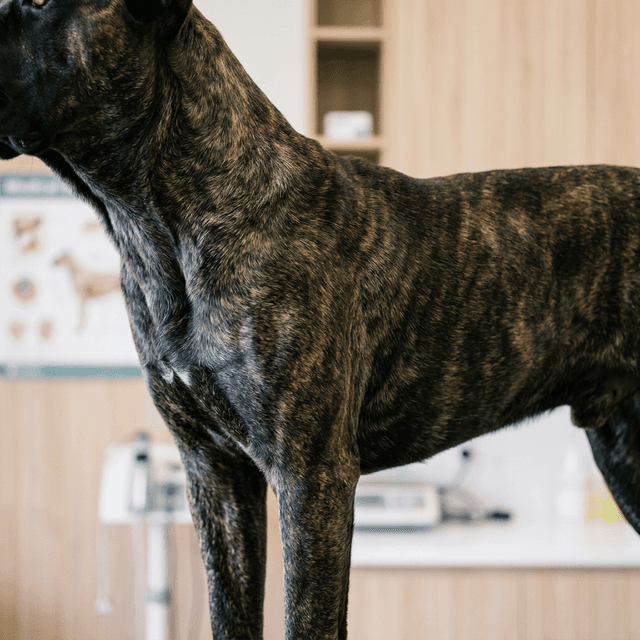
The anatomy here is pretty straightforward once you see it. In a deep-chested breed, the stomach sits in a long, narrow chest cavity with more vertical space than lateral support. Compared to a stocky, wide-bodied breed where the stomach is held more snugly in place, the deep-chested dog's stomach has more freedom of movement. More room to expand. More room to rotate.
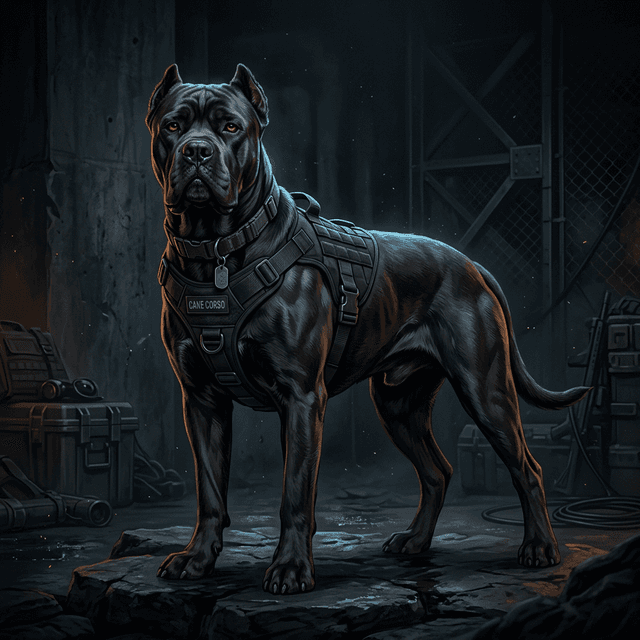
Cane Corsos, given their deep sternum, wide ribcage, and significant body mass, sit squarely in the high-risk category. So do Great Danes—statistically the breed with the highest GDV incidence—along with Standard Poodles, Irish Setters, German Shepherds, and most Mastiff-type breeds.
Beyond anatomy, there are several contributing risk factors that compound the danger:
- Eating too fast: Dogs that inhale their food swallow significant amounts of air in the process. That air has to go somewhere.
- Large, infrequent meals: One giant meal a day puts a massive volume of food into the stomach at once, increasing expansion risk.
- Exercise around mealtimes: Vigorous activity before or after eating can cause the stomach to shift position when it's most vulnerable.
- Age: Older dogs are statistically at higher risk, likely because the ligaments that hold the stomach in place loosen over time.
- Genetics and family history: If a first-degree relative has had GDV, the dog's own risk increases meaningfully.
- Elevated food bowls: This one is counterintuitive—for years, raised bowls were recommended to reduce bloat risk, but more recent data actually suggests they may increase it in large breeds. Worth discussing with your vet.
- Restlessness, pacing, inability to settle
- Repeated unproductive retching—the dog is trying to vomit but nothing comes up
- Distended, tight abdomen (sometimes visible, sometimes only felt)
- Excessive drooling
- Obvious discomfort when the belly is touched
- Pale or white gums
- Rapid, shallow breathing
- Weakness, collapse
- The dog looks "off" in a way that's hard to articulate but unmistakable to anyone who knows their dog
Recognizing the Symptoms Before It's Too Late
This section is the one to read twice. Because GDV symptoms can look vague in the early stages, and that vagueness costs time.
Early warning signs:
As it progresses:
Here's the critical rule: if your deep-chested dog is retching without producing vomit and showing any abdominal distension, you do not wait to see if it passes. You go to an emergency vet immediately. Call ahead so they can prepare. Do not stop for food, do not wait until morning, do not Google it for another twenty minutes. Go.
Unproductive retching in a large breed is a GDV signal until proven otherwise.
The Feeding Protocol That Reduces Risk
You can't eliminate GDV risk entirely—some of it is anatomical and genetic. But you can reduce it substantially with a consistent feeding protocol, and that's absolutely worth doing.
Split meals, not one big one. Feed your Corso twice a day rather than once. This reduces the volume of food in the stomach at any given time and limits the expansion that can set the stage for twisting. Some high-risk dogs do better on three smaller meals. Talk to your vet about what makes sense for your dog's size and weight.
Slow the eating down. If your dog inhales food—and many Corsos do, competitive feeders by nature—a slow feeder bowl or a snuffle mat significantly reduces air ingestion. These aren't gimmicks. The difference in eating speed between a standard bowl and a well-designed slow feeder is dramatic.
Respect the two-hour rule. No vigorous exercise for at least two hours after eating. This is the single most consistently cited behavioral prevention measure in veterinary guidance on GDV. The stomach needs time to begin emptying before you're asking the dog to run, jump, roughhouse, or do anything that involves significant body movement. A calm walk is generally fine. A game of fetch, a training session with a lot of movement, or any kind of excitement that gets the dog's body rotating and jostling? Wait.
This is worth building into your daily routine as a non-negotiable. Feed, then rest. The timer starts at the last bite. Two hours minimum before anything strenuous. Some owners set a literal reminder on their phone until it becomes habit—and honestly, that's not overkill. It's the kind of small discipline that could save your dog's life.
Water management. Letting a very thirsty dog drink massive amounts of water immediately before or after eating can contribute to stomach distension. Keep water available throughout the day so your dog isn't arriving at mealtimes parched and gulping.
The Prophylactic Gastropexy: A Conversation Worth Having
If your Corso is at elevated risk—based on breed, body type, family history, or your vet's assessment—there's a surgical option called a prophylactic gastropexy that's worth knowing about and discussing seriously.
A gastropexy is a procedure in which the stomach is surgically attached to the abdominal wall, preventing it from rotating. It doesn't prevent bloat—the stomach can still distend with gas—but it makes the life-threatening twist mechanically impossible. When performed prophylactically (meaning before any GDV event, not as emergency surgery), it's a relatively straightforward procedure that's often done at the same time as a spay or neuter to reduce anesthesia events.
For high-risk breeds, the evidence supporting prophylactic gastropexy is strong. A dog that has already survived one GDV episode has a very high chance of a second one—for those dogs, gastropexy isn't optional, it's standard. For young Corsos with strong family history or extreme deep-chest conformation, it's at minimum a serious conversation.
Not every vet will bring this up proactively. Ask about it directly.
Building a Safety Routine Around Mealtimes
Prevention isn't a single decision—it's a set of daily habits that compound over the life of your dog. The owners who successfully protect their large breeds from GDV aren't doing anything heroic. They're just consistent.
Feed twice a day. Use a slow feeder. Enforce the two-hour rest window after every meal. Know the symptoms cold—not vaguely, but specifically. Have your emergency vet's number saved in your phone *now*, not when you need it. Know the route.
Some owners use a Bloat Safety Timer—a simple tool that tracks the two-hour window after meals and sends a reminder when it's safe to exercise. It sounds almost too simple to bother with, but routine is where prevention lives. When you're busy, distracted, or it's been a long day, a reminder that says "wait thirty more minutes" is exactly the kind of guardrail that matters.
Lifetime Cost Calculator
Plan your long-term financial commitment.
---
Final Thought
The deep chest that makes a Cane Corso so physically impressive is the same anatomy that puts them at risk. That's not a flaw—it's just the reality of the breed, and responsible ownership means facing it clearly.
Bloat and GDV don't give you much time to react. But they give you plenty of time to prepare. The feeding schedule, the slow feeder, the two-hour rule, the conversation with your vet about gastropexy—none of this is complicated. It's just the kind of care a dog this magnificent deserves.
Know the signs. Build the habits. Keep the vet's number close...